|
|
|
POLISH MERCHANT NAVY COLLEGE |
| |
|
|
| |
|
The creation
of a Polish Merchant Navy College was first mooted in 1942 but it wasn't
until March 1945 that the necessary resources were found for the college
to be established, under the direction of Cpt. K.O. Borchardt, in a
disused camp in Landywood nr. Walsall in Staffordshire. |
| |
|
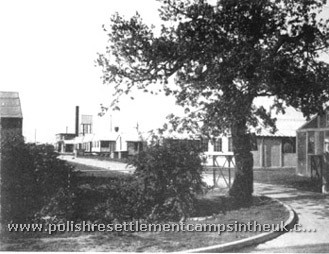
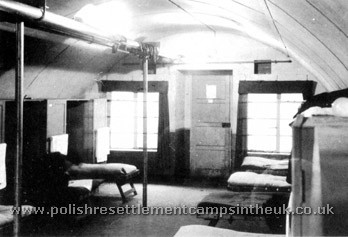
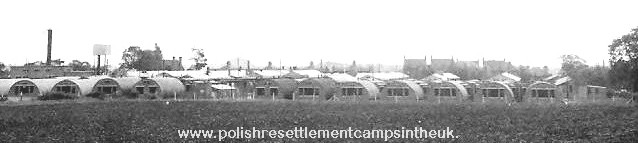
The camp
consisted of the usual assortment of nissen huts which served as
classrooms and bedrooms for the boys. There was a communal kitchen
and dining room, doctor's surgery, chapel, workshops and staff
accommodation. The college, as remote from the sea as could be in
the U.K., laboured under many disadvantages not the least of which was
that the British merchant navy did not recognize its nautical training or
qualifications. |
| |
|
 |
 |
 |
|
Polish Merchant Navy college at
Landywood Great Wyrley Staffordshire |
|
| |
 |
|
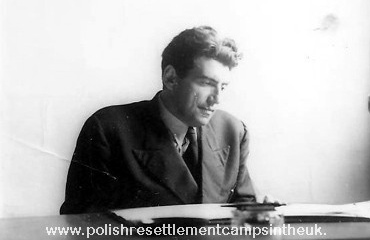
Karol Olgierd Borchardt
Head of department of the Naval College, |
|
 |
|
The camp in Landywood, Great Wyrley, Nr Walsall. |
|
| |
| At the outbreak of World War II, kpt.
Karol Olgierd Borchardt served as a senior officer on the sail
training ship "Dar Pomorza" and was interned in Sweden from
where he managed to make his way to Britain. He first served
on the SS "Piłsudski" and, having survived its sinking, went
on to take part in the Narvik campaign on the SS "Chrobry".
He was wounded during the sinking of the "Chrobry". He went
on to work in Polish education in England and after the war
served on the British ship 'Sheridan' serving South American
ports. |
|
|
|
| |
|
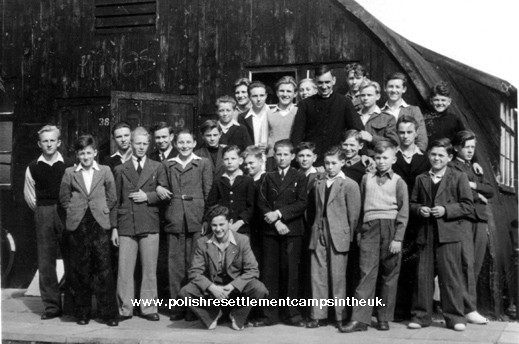
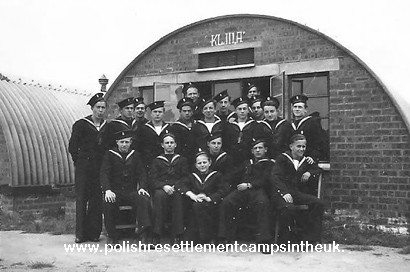
The students from 4a in their full naval uniforms in
front of their classroom 1947 |
 |
|
Some of the names |
| Romuald Dunajec |
| Czarnecki Zenon |
| Radkiewicz Henryk |
| Sadowski Janusz |
| Bergel |
| Lewszuk Michał |
| Wrzyszcz Eugeniusz |
| Peszyński Oskar |
| Pszybysławski Kazimierz |
| Kazik Przybystawski is in the middle row
second from left. |
| Tamulewicz Edmund |
| Bernacki Władysław |
| Gałuszka Franciszek |
| Kotlarczyk Zbigniew |
| Martynowicz Józerf |
| Bełch Edward |
| Klecuń Roman |
| Wądołkowski Zbigniew |
|
 |
|
| |
|
 |
 |
 |
|
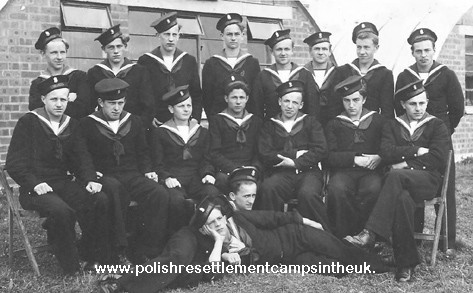
After the last lesson of the day with professor Stadnik.
Class 4a September 1946 |
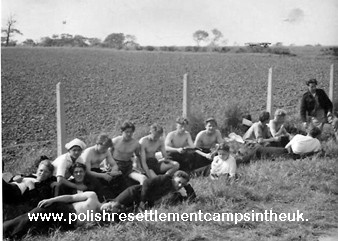
Outdoor lesson near the school one lovely
afternoon in May 1947 (Holly Lane) Landywood. |
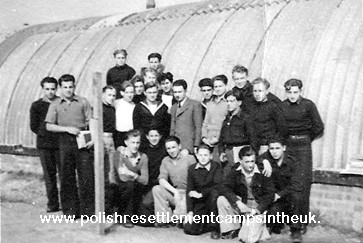
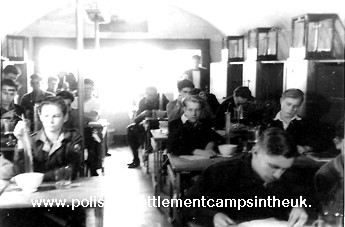
Physics class 3 in one of the Nissen huts
Sept. 1945. |
|
| |
|
 |
|
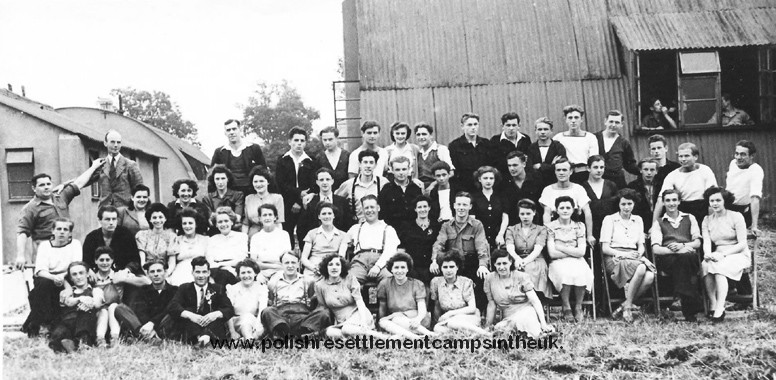
Students from the Polish Naval College Landywood on their rest period with the local land girls working
during the summer holidays on the farms (Photograph submitted by Barbara
McMullen nee Przybysławska). |
|
|
|
|
Photograph submitted by Barbara McMullen nee Przybysławska daughter of Kazik Przybysławski
who attended the collage completing the course in 1949 |
|
|
|
|
|
In 1947 The
Committee for the Education of Poles, under the chairmanship of Sir George Gater, assumed responsibility for the college and took the
view that it should be merged with the Lilford Technical School. The
merger was completed by March 1948 and two special classes, in navigation
and engineering, were formed for 45 advanced students from Landywood. The
committee also managed to arrange navigational practice for most of the
trainees. These two classes, which were independent of Lilford's
technical curriculum, disappeared in 1949 when the students completed
their course. |
| |
|
Lilford school
Northamptonshire |
|
| |
|
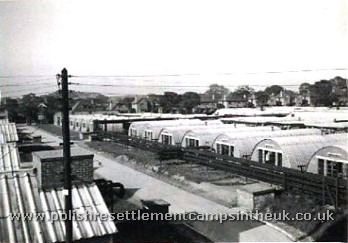
Some time in the early 1940s, as part of the war effort a large camp was
built on park land around Lilford Hall in
Northamptonshire. From 1943 until the end of the war the camp served as
an American Air Force 303rd station
hospital. With the end of
hostilities the camp stood unused until 1947 when the empty large Nissen
huts that once served as hospital wards were transformed in to dormitories
and class rooms of the Polish
Technical School. |
| |
|
Of all the Polish schools in the
U.K. Lilford was by far the most interesting. The product of a merger
between Landywood Merchant Navy College (December 1947) and Burma Camp
Engineering School near Llywyngwril Merionethshire (March 1948) Lilford
became a mixed ability Technical School catering for boys in the age range
of 13 to 17. |
| |
|
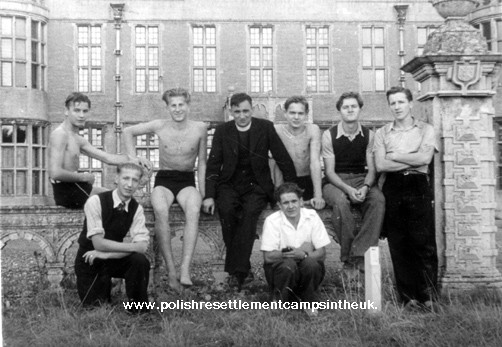
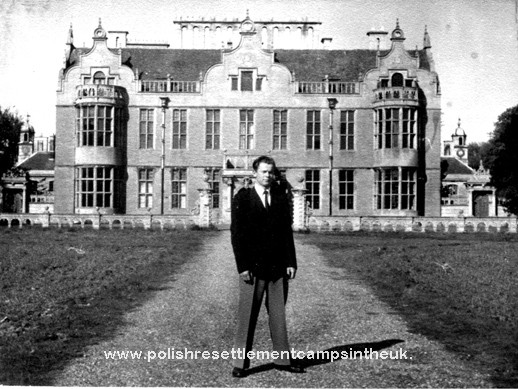
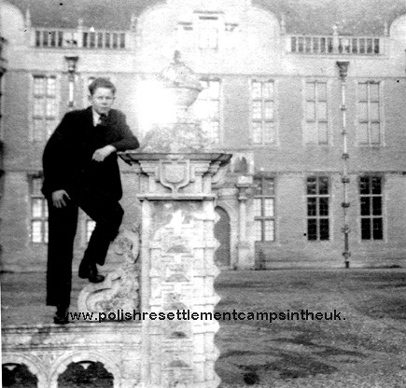
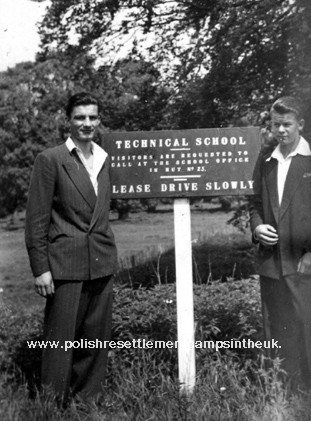
Aleksander Puchnarewicz
in front of Lilford Hall 1948 |
 |
 |
|
|
|
Aleksander came to the UK in 1948 with his
mother Anna and older brother Antoni from Koja camp in East
Africa to join their father Michał who arrived
earlier with his army unit from Italy. At the age of 14
Aleksander was sent to Lilford school to complete his education. |
| |
|
|
|
|
|
Initially the school provided two
courses, one of 3 and the other of 4 years, both of which were designed to
train boys for the mechanical engineering industry while at the same time
providing them with a broad general education. |
|
|
|
By the start of the
school year 1950/51 the two courses were merged onto a single syllabus
delivered through five ability streams catering for varying skills and
levels of achievement. Younger boys would be scheduled to complete
the course within four years and be expected to achieve a high academic
standard, while older boys would concentrate on workshop practice that
would prepare them for entry into the world of work. |
| |
 |
 |
|
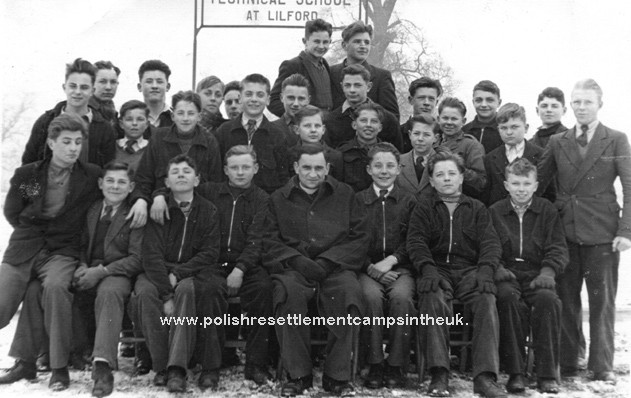
Students from Lilford with one of their teachers,
Aleksander is standing on the right. |
|
|
| |
|
This varying
emphasis, within a single syllabus, can be seen in the amount of time
spent in the workshops. Boys following the more academic 4 year
course spent a total of 1,587 hours in the workshops while boys on the
more vocational 3 year course spent 2,160 hours in the workshops.
It was recognised early on that pressure from boys to acquire practical
skills which would provide them with well paid jobs in industry might lead
to unacceptable levels of achievement in the humanities. |
| |
|
Indeed masters,
responsible for delivering subjects of general education, struggled to
capture the boys' interest. To support them, the former principal of
Haydon Park Grammar School, Henryk Staszewski who had already demonstrated high intellectual
and administrative gifts, was appointed as headmaster in February 1951.
Under his direction the school, now consisting of well over 400 boys,
flourished with its standards of general education considerably enhanced
and without detriment to the standard of practical work. |
| |
|
 |
 |
|
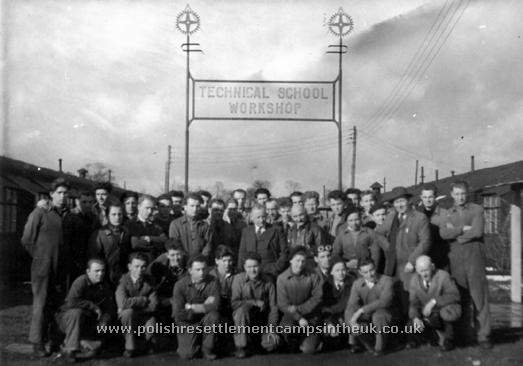
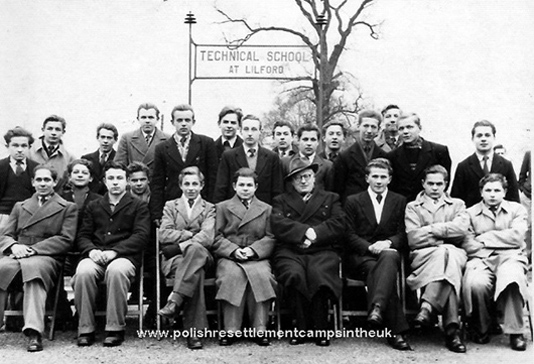
Pupils and staff . |
1948-1949 Photo contributed by Stanisław
Nowak sitting next to Prof. Chomyszync |
|
| |
|
Taking advantage of the boarding
character of the school, classes were arranged to provide a two hour
break at mid day enabling the boys to take part in social and sporting
activities, in full day light, throughout the year. During this
period of leisure the boys, of their own initiative, levelled football
pitches, built a grandstand, prepared the ground for tennis courts,
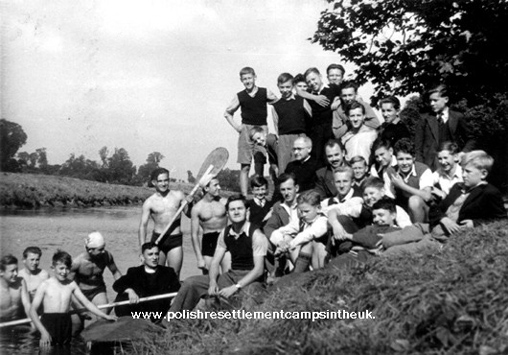
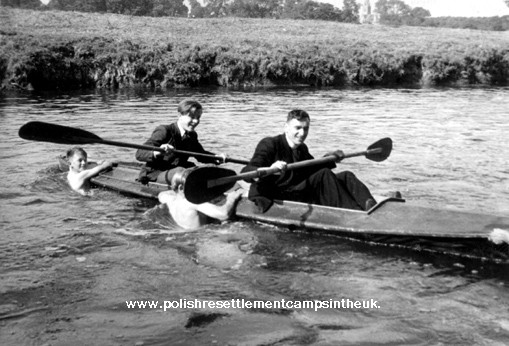
made basket ball posts and, given the proximity of the river Nene,
built six canoes. Sport thus became highly developed and the school's
record of sporting success was indeed impressive. |
|
|
|
|
| |
|
From 1951 pupils were entered
for the East Midlands Education examinations thereby giving them entry
to National Certificate courses at British technical colleges. The
results of their efforts, given the language difficulties, were
impressive and are summarised below. |
| |
|
FIRST YEAR NATIONAL CERTIFICATE .SENIOR 1 |
| |
June 1951 |
June 1952 |
June 1953 |
June 1954 |
| Subjects |
Entries |
Passes |
Entries |
Passes |
Entries |
Passes |
Entries |
Passes |
| Mathematics |
20 |
20 |
42 |
42 |
64 |
58 |
29 |
29 |
| Engineering Drawing |
20 |
20 |
45 |
41 |
65 |
60 |
28 |
27 |
| Mechanics Engineering |
20 |
17 |
28 |
17 |
12 |
12 |
19 |
19 |
| Science. |
|
|
17 |
17 |
38 |
35 |
7 |
6 |
|
|
PRE-SENIOR TECHNICAL EXAMINATIONS |
| |
June 1951 |
June 1952 |
June 1953 |
June 1954 |
| Subjects |
Entries |
Passes |
Entries |
Passes |
Entries |
Passes |
Entries |
Passes |
| English |
26 |
14 |
22 |
21 |
22 |
21 |
17 |
14 |
| Mathematics |
26 |
26 |
22 |
22 |
22 |
22 |
17 |
16 |
| Science. |
26 |
23 |
22 |
21 |
22 |
22 |
17 |
15 |
| Drawing |
26 |
26 |
22 |
22 |
22 |
22 |
17 |
17 |
| |
|
|
|
|
|
|
|
|
|
|
|
|
By 1953 most Polish children had
acquired sufficient English to enter directly into the British education
system so, in September 1953, all remaining Polish secondary school
pupils, both boys and girls, were formed into one school at Lilford. |
|
|
|
Lilford School attracted the
attention of both the local population, which eagerly attended open days
and was greatly impressed by exhibited examples of the pupils' work, as
well as educationalists who wrote highly complementary articles in various
educational journals. The directors of an important local engineering
company were sufficiently impressed by the boys' work to subcontract the
manufacture of parts to the school, on normal commercial terms, so giving
the course an important quality of reality. |
| |
|
 |
|
 |
|
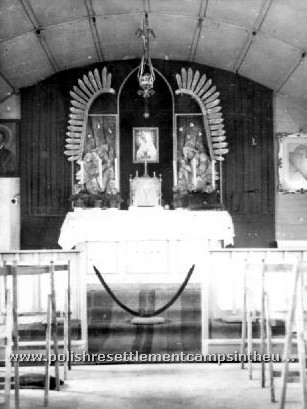
The school chapel in 1949 |
|
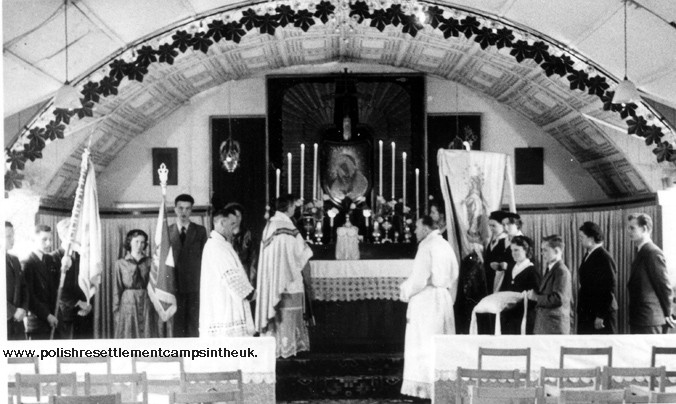
School chapel refurbished in the 1950s |
|
| |
| |
|
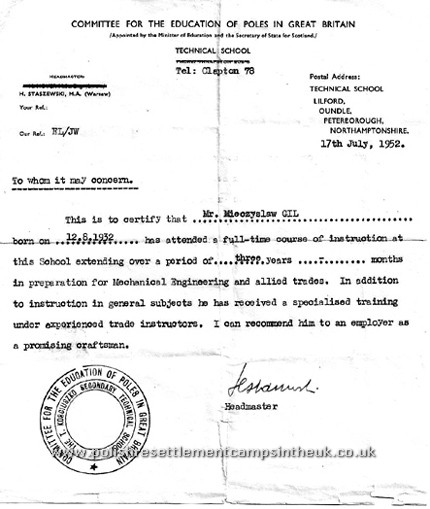
Mieczysław
Gil was one of the many boys who attended
Lilford school |
| |
| Mieczysław Gil
age 14 and his widowed mother Rozalia age 45,
arrived, in Southampton from Cape Town on board
the R.M.S. Arundel Castle on the 30 May 1948 with 600 Polish
displaced women, children and elderly from camps in
Rhodesia.
His
father, a polish soldier was killed in action |
 |
|
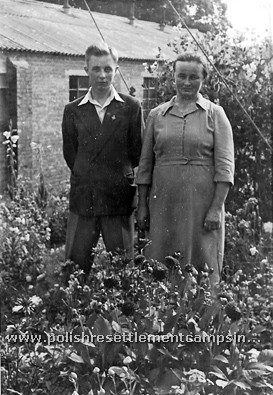
Mieczysław
with his mother in
Northwick Park. |
|
|
in
Italy and is buried in the Polish Army cemetery in Loreto.
|
|
|
|
On
arriving in the UK they were
sent to Daglingworth camp in Gloucestershire, which, at that
time served as a transit camp for all new arrivals. They were then
relocated to Northwick
Park, where his mother lived until 1960, when she moved to
Swindon |
|
|
|
Not knowing the
language Mieczysław, with a group of
boys from different camps was sent to Fairford camp on an
intense two month English course. He travelled to Fairford in a truck which was laid on for them. With in a
month of finishing the course and returning to
his mother in Northwick, Mieczysław was
sent to
the Polish boarding Technical
School for boys in Lilford
Northamptonshire, where he spent 3 years studying
mechanical engineering, leaving when he was 19.
|
| |
|
All this time his mother was living in Northwick Park and saw her son only
during half term and school holidays. To earn some pocket money Mieczyslaw recalls that in the summer holidays he worked on local farms
gathering potatoes, fruit and vegetables.
He also
remembers
dances and social events that were held in Northwick and
visiting other camps in the area, like Springhill, Fairford
and Daglinworth. |
|
|
 |
|
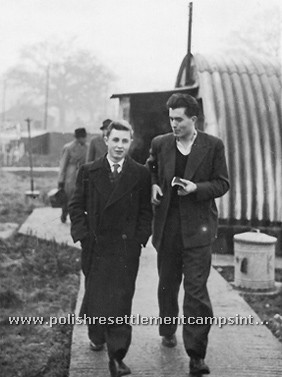
Mieczysław and friend
Roman Krzywinski in Northwick Park |
|
|
His
first job after leaving the boarding school was with Dowty's in
Ashchurch, then 8 years at Telehoist in Cheltenham, eighteen months in
London and finally, in 1960, he joined Pressed Steel Fisher, now
BMW, in Swindon where he worked for 35 years until his retirement
in 1997. He married Józefa in 1963 and has a son, daughter and two
grandsons. |
| |
|
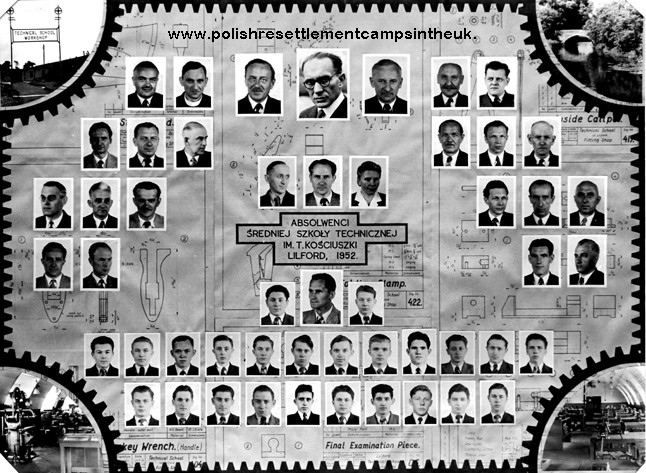
Mieczysław's
Leaving Certificate and photo of absolvents and teachers from
LILFORD 1952 |
| |
|
|
| |
|
| Many thanks to Krystyna Tworek
for collecting the information and photos. |
|
|
|
| |
| |
|
Stefan Minkiewicz
short
Resume. |
| |
|
Stefan was born on 29 April 1936 in Bujnowicze in the
district Nowogródek,
which was in Poland before WW2 and now is part of Belarus.
On the 10th of February 1940 the whole family were deported with
thousands of other Poles to the depths of Siberia. In 1942 the family
joined the General Anders army exodus through Uzbekistan to
Persia, his father joined the army whilst Stefan and his mother,
as civilians, moved from camp to camp; Teheran, Ahwaz and Karachi, ending up in camp Vallivade in India
where
they lived for four years and where Stefan attended the
Polish junior school in the camp. |
| |
| The family left India bound for the
UK on the Empire Brent arriving in Southampton on the 26th
September 1947. They joined their father in Oulton Park army camp
in Cheshire and after demobilisation the family moved to
Delamere Park Polish camp also in Cheshire were they lived until
1963. |
| |
|
Stefan now a teenager was sent to Lilford
school were he studied engineering for 4
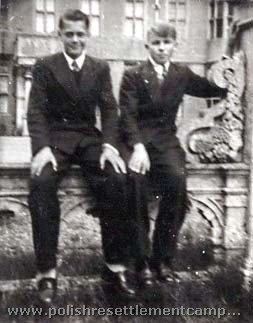
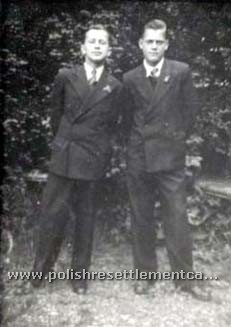
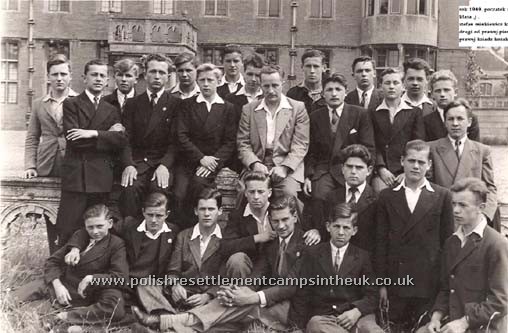
years. Below are photos of Stefan and friends in their first year
at the school. |
|
|
| |
 |
|
Stefan Minkiewicz with
friend Stefan Scigała. |
|
|
 |
|
Stefan with friend Stasior. |
|
 |
|
First year of "J"
class 1949 first on the right Krzysztof
Kozakiewicz, he become a priest, Stefan Minkiewicz,
Janusz Stachura, Krajewski, Zygmunt Smolicz, Edward Obłoj,
Holwerger, Eugeniusz Kuczyski, Henryk
Szostak, Standing:- Bogdaniec, Eugieniusz Imiołek,
Łopacki, Jerzy Rusiecki, Skrzypek,
Edward Partyka, Henryk
Okołotowicz, Profesor of geography and
class master Mr. Mycka, Miłosz Powiecki, Julian
Moźdzer, Śydor, Zbigniew Narożny, Jan Kurczak, Stefan
Scigała, Stasior, Marian Abramczyk. |
|
|
| |
|
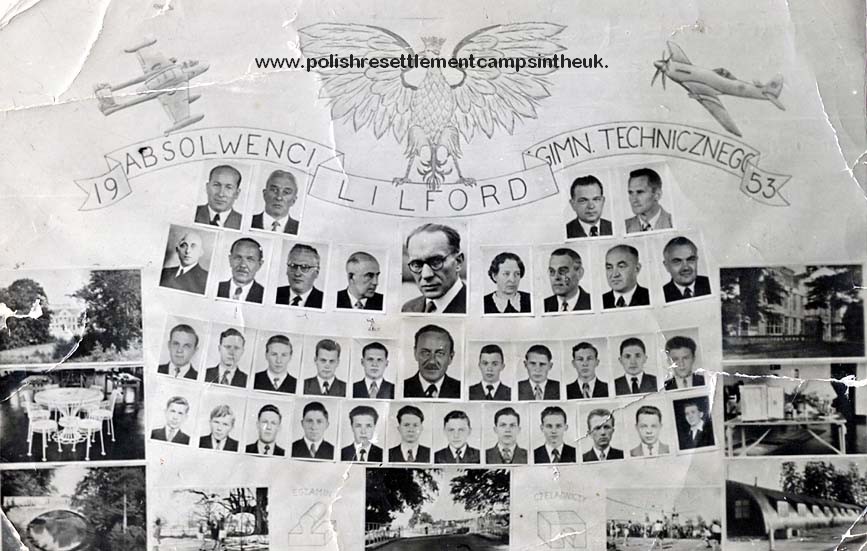
Commemorative photo of
teachers and graduates 1953 |
|
| |
|
|
| |
|
Although Stefan graduated with a grade 'A'and
received his qualifications in engineering, he was better known
for his sporting prowess than academic achievement |
|
playing in the school's football and
basketball teams.
|
| |
|
After graduating Stefan lived
in Birmingham for a year and then moved to
Manchester were he lived for 12 years close to his parents who
were still living in Delamere camp. While living in Manchester
Stefan was closely involved in the Polish community and in
particular the sports club Polonia were he continued his
sporting passion. In 1966 he emigrated with his
wife, 4 year old daughter and 1 year old son to Hamilton Ontario
Canada. |
| |
 |
|
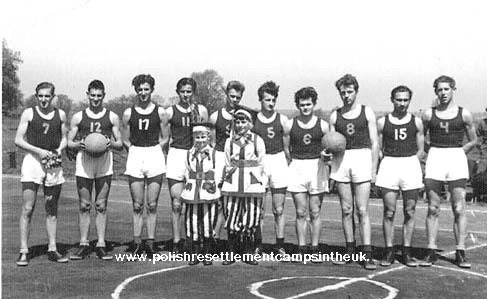
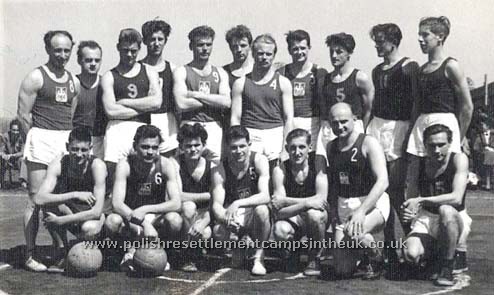
Schools basketball
team 1952 Kwaśniewski, Zygmund Smolicz, Derecki.
Julian Moźdzer, Stefan Minkiewicz,
Zbigniew Kardasinski,
Dworkowski, Tworogal, Stefan Zyskowski, Chojnowski. |
|
 |
|
School team that
played against AZS Polish faculty of London University |
|
|
| |
 |
|
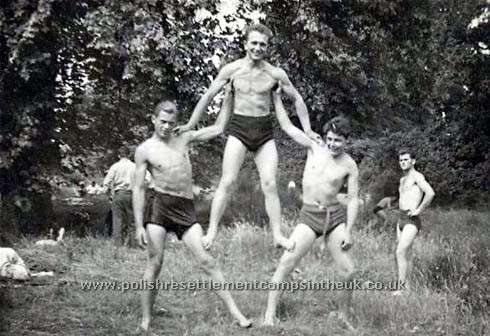
Stefan Minkiewicz,
Jan Kurczak and Miłosz
Powiecki by the river Nene |
|
|
 |
|
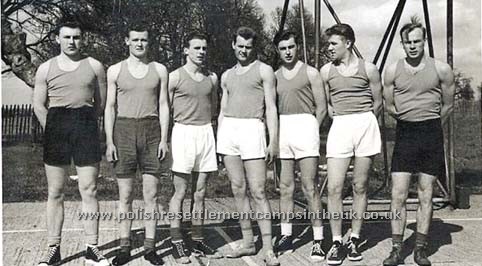
Polonia Manchester basketball
team; all are alumni from Lilford school. 1955. Names that Stefan
recalls;. Szaleniec, Romuald Malczyński, Mieczyslaw
Imiotek, Stefan Minkiewicz, Jerzy Kozławski, Bogdan,
Maliszewski and Proszański. |
|
|
| |
 |
|
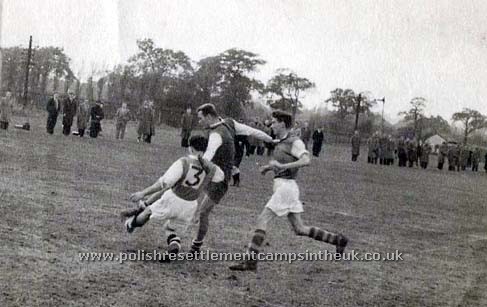
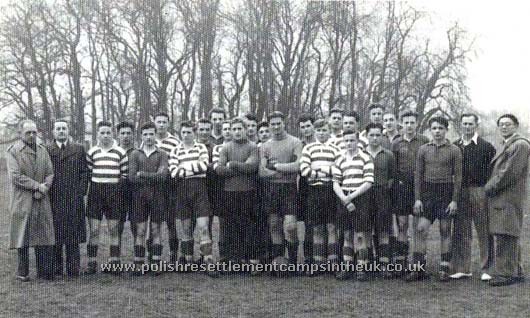
1955 Football match Polonia Manchester
v Lilford School, Stefan is in the middle. |
|
 |
|
Football finals
between class "J" and "E" 1952. |
|
On the right the
schools director Professor H. Staszewski next Professor
Juliusz Kluk, pre war Polish vice-champion in the
pole vault. |
|
|
| |
| Thank you to Stefan
Minkiewicz for the photos and information. |
|
|
| |
|
If you attended Lilford Polish School and would
like to contribute memories and photos please contact me. |
|
|
|
Page 1 current |
|
Page 2
More photo including two from 2013 and 2015 reunion |
|
Page 3
School photo 1955 |
|
Back to education |
|
Home |
|
|